Monday, June 25, 2012

Free E-Learning University of People


Many university offer on line e-learning program and course, but for university of the people (UoPeople) is unique and different. (UoPeople) is supported by United nations, Yale University, Ashoka, New York university, Hewlett Packard (Hp), PNB, OCW, and Clinton Global Initiative.

University of the people is the world's tuition free, non-profit, on line academic institution dedicated to opening access to higher education globally. The method of learning by combines peer-based and collaborative learning, with information technology and internet, online study communities, discuss, submit assignments and take exams. Student who study in University of the People will minimize the budget without sacrificing the quality of education. When you join and accepted as a student in University of People, you can start study by same learning model includes lessons, classes, discussions, readings, assignments and exam like any university. With flexible time to study, student receive maximum freedom in choosing their location and hours of study.

University of the People offers the following four undergraduate degrees: Associate (A.S.) and Bachelor (B.S.) degrees in Computer Science and Associate (A.S.) and Bachelor (B.S.) degrees in Business Administration. Then All Exam are administered online. To meet application requirements, the applicant needs to be over the age of 18, be able to demonstrate secondary school completion with the presentation of a certified diploma and a transcript, and be proficient in the English language.

If You are interested you explore more in University of People website to study e-learning, join with thousands of student from around the world, and good luck for your future and get your success.

If You want to star your application you can click here.

Saturday, June 16, 2012

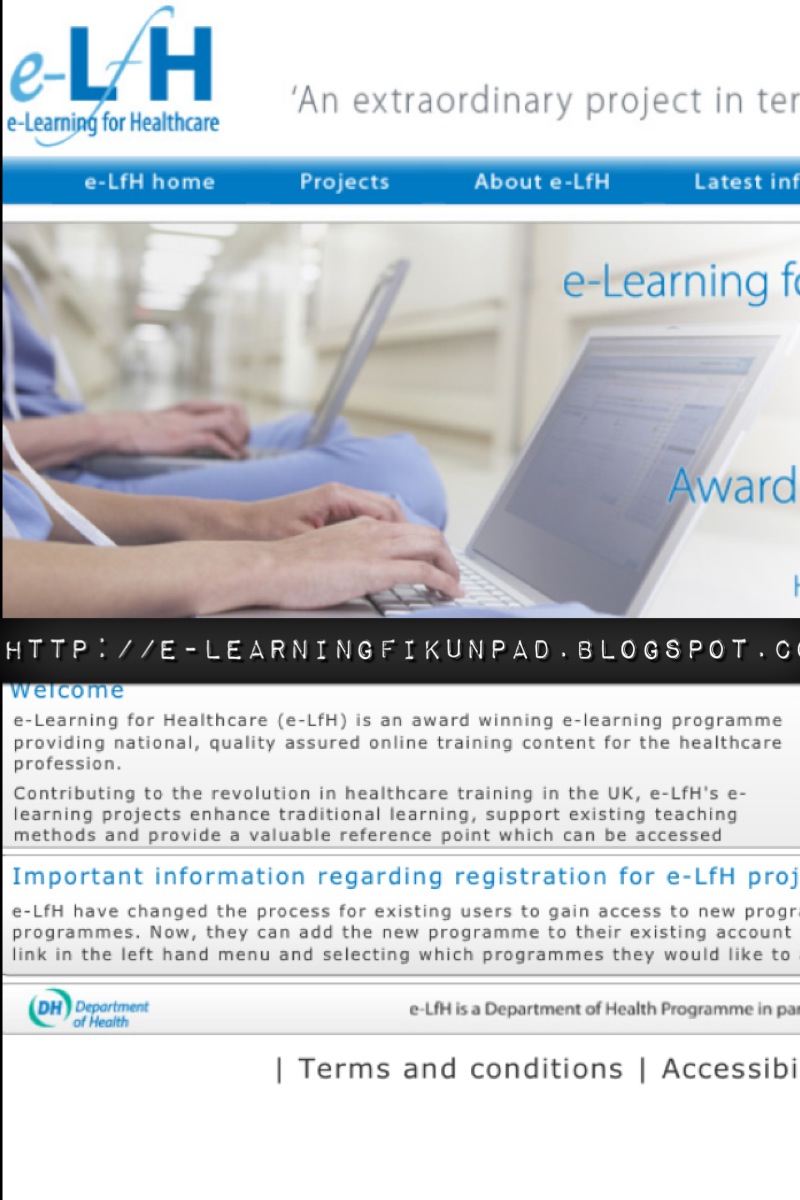
E-learning for Health care

E-learning for Health Care

If you are looking for free web site for health care profession online training content, you can open www.e-lfh.org.uk. This website provides e-learning for health care, supports existing teaching methods and provide a valuable reference point which can be accessed anytime, anywhere.

E-Learning for Health Care is a department of health program in partnership with the NHS UK and professional bodies providing high quality free content from audiology to anesthesia, dentistry to dermatology, pathology to pharmacology, by providing 24/7 access to online.

E-learning for health care is designed and built to be engaging and interactive, using quality images, video, audio and animation to help trainees learn real-life scenarios, cases study and knowledge. You can try to open and explore with demo page.

E-learning for health care is advantage for nurses who want to prepare NCLEX-RN exam, and for other health profession who want to improve their knowledges and skill experiences in their fields.

You just sign up in e-learning for health care and enjoy the study materials.

Saturday, June 2, 2012

E-learning for Kids

E-learning for Kids


If you are searching online e-learning program for your kids to teach reading, math, science and computer, you can try to open e-learning program for kids website, it is available in many languages, english, nederlands, francais, espanol and portugues. With many volunteer staffs who consists of committed education and e-learning experts and business professionals from around the world with their vision is to be the source for childhood learning on the Internet – available from anywhere and without charge. Established in late 2004, e-Learning for Kids is a global, nonprofit foundation dedicated to fun and free learning on the Internet for children ages 5 - 12. They offer free, best-in-class courseware in math, science, reading and keyboarding; and we’re building a community for parents and educators to share innovations and insights in childhood education.

This web site is not advantage only for children but also guide line for parents who want to get more engage in their kids education, for educators and experts champion e-learning and contribute their knowledge on how kids can learn better. For Commercial education and game developers, for corporations and associations channel and for people with a passion for childhood education make a difference.

Saturday, January 10, 2009

How to Treat Bedsores

Step 1
Be sure not to massage any reddened areas of the skin, especially those over bony prominences.

Step 2
Keep all pressure off of the reddened or ulcerated area. The sore will not heal until all pressure is removed.

Step 3
Clean the bedsore, if it is ulcerated, with gauze soaked in sterile water or normal saline. Use a gentle cleansing solution to reduce tissue damage.

Step 4
Use betadine swabs (gauze pads soaked in betadine solution) to clean infected bedsores. Wear sterile gloves. Always clean the wound from the center and work out towards the edges. You want the germy debris to get dragged out and away from the ulcer.

Step 5
Obtain a culture, if the ulcer is infected, as ordered by your doctor. A culture will tell you what germ is growing inside the ulcer so that your doctor can prescribe the proper antibiotics.

Step 6
Talk to your doctor about debriding the ulcer. When you debride a wound, you remove the dead tissue, allowing the pink, healthy tissue to flourish.

Step 7
Apply an occlusive dressing over the bedsore, as ordered by your doctor. These dressings are usually clear, and protect the bedsore from worsening by allowing the migration of fresh skin cells.

Step 8
Consider surgery for bedsores that will not heal, including incision and drainage, skin flaps, skin grafts and bone resection.


Source: http://www.ehow.com/how_13175_treat-bedsores.html

Friday, December 19, 2008

432 The Journal of Continuing Education in Nursing · September 2008 · Vol 39, No 9
resource reviews
Susan C. Haussler, EdD, RN, CNE
Associate Editor
Stressed Out About
Communication Skills
by Kathleen Bartholomew; 2007;
Marblehead, MA: HCPro, Inc.; 153
pages; $29.95; softcover.
This timely book is written for
entry-level students in nursing
and health-related disciplines and
novice nurses. Communication encounters
(nurse to patient, nurse to
nurse, nurse to physician, and nurse
to manager) are clearly presented
in an easy to follow format. Practical
tips and strategies for effective
communication are provided. Visual
symbols are consistently used
throughout the book to orient the
reader to particular passages. The
final chapters outline excellent strategies
for developing and exploring
communication techniques in
a variety of settings and personal
encounters. The final page encourages
the reader to develop his or her
voice within the discipline of nursing.
Often humorous, Bartholomew
shares her nursing experiences and
encounters over the years in the
hope of facilitating the communication
process across the health care
continuum.
Stressed Out About Communication
Skills clearly orients the reader
to effective communication skills
and strategies. These skills and strategies
are applied to a variety of settings
and encounters that nursing
students and novice nurses will face.
I fully recommend this book for its
content, style, and importance.

Thomas W. Connelly, Jr., PhD, RN
Director, ASN Program
Anna Maria College
Paxton, Massachusetts

The Johns Hopkins
Nursing Evidence-Based
Practice Model and
Guidelines

by Robin P. Newhouse, Sandra L.
Dearholt, Stephanie S. Poe, Linda C.
Pugh, and Kathleen M. White; 2007;
Indianapolis, IN: Sigma Theta Tau
International; $29.95; 224 pages;
softcover.

Health care today exemplifies a
culture of improving quality,
promoting patient safety, supporting
practice with evidence, and closing
the traditional gap between research
and practice with knowledge. Regarding
this culture, “nursing interventions
and processes informed by
the best evidence are critical to realizing
healthcare improvements” (p. 3).
The Johns Hopkins Nursing
Evidence-Based Practice Model and
Guidelines demystifies evidencebased
practice. This book describes
the model and its guidelines in a practical,
reader-friendly manner that the
student, the new nurse beginning
his or her career, and the extremely
experienced practitioner would find
useful. This book goes beyond the
discussion of the model—it provides
health care organizations with key
strategies for implementing model
concepts, effective tools to define
nursing problems or issues, and
sample forms to test the model. Its
well-structured index helps readers
quickly locate key sections of the
text.
The Johns Hopkins Nursing
Evidence-Based Practice Model and
Guidelines would be an extremely
valuable addition to any nursing
library, education department, or
nursing practice or research council.
Linda J. Curtin, RN, PhD, CCRN
Director, Nursing Practice, Education and
Research
Caritas Good Samaritan Medical Center
Brockton, Massachusetts

Thursday, December 11, 2008

Nursing theories

Nursing theories

A) Example of grand theories

  1. Faye G. Abdullah : Patient-Center Approaches to nursing
  2. Virginia Henderson: The principles and practice of nursing
  3. Dorothea E. Orem: The self-care deficit nursing theory.
  4. Dorothy Johnson: The behavioral system model.
  5. Betty Neuman: The Neuman system model
  6. Imogen king: Kings systems framework and theory of goal attainment
  7. Myra E. Levins: The conservation model
  8. Sister Callista Roy: The Roy adaptation model
  9. Jean Watson: Nursing-Human science and Human caring
  10. Martha Rogers: The Science of Unitary and irreducible human being.
  11. Margerate Newman: Heath as expanding consciousness
  12. Rosemarie Parse: The theory of human being

B) Example of borrowed theories

Theories from sociology

2. General system theory

3. Role theory

4. Feminist theory

5. Critical social theory

6. Theories from behavioral science

7. Psychoanalytic theory

8. Interpersonal theory

9. Operant conditioning

10. Human needs theory

11. Person-centered theory

12. Stress, coping, adaptation theory

Theories from medical sciences

  1. Germ theory and principles of infection
  2. Homoeostasis
  3. Theories of immunity and immune infection
  4. Genetic principles and theories
Pain management: Gate control theory

Applications of Dorothea Orem’s Self- Care Deficit Nursing Theory

According to Orem (2001), it is the special focus on human being
that disthinguishes or differentiates nursing from other human
services. From this point of view, the role of nursing in society
is to enable individuals to develop and exercise their selfcare
abilities to the extent that they can provide for
themselves the amount and quality of care required.
According to the theory, individuals whose
requirements for self-care exceed their capabilities
for engaging in self-care are said to be experiencing
a self-care deficit.Moreover, it is the presence of an
existing or potential self-care deficit that identifies
those persons in need of nursing. Thus, Orem’s
Self-Care Deficit Nursing Theory explains when
and why nursing is required.
Orem (2001) describes the Self-Care Deficit
Nursing Theory as a general theory of nursing.
General theories of nursing are applicable across all
practice situations in which persons need nursing
care. As such, the Self-Care Deficit Nursing Theory
describes and explains the key concepts common to
all nursing practice situations (Orem, 1995). The
theory consists of four concepts about persons
under the care of nurses, two nurse-related concepts,
and three interrelated theories (the Theory of
Nursing Systems, the Theory of Self-Care Deficit,
and the Theory of Self-Care). Concepts in the general
theory include, self-care, self-care agency, therapeutic
self-care demand, self-care deficit, nursing
agency, and nursing systems. The theory describes
and explains the relationship between the capabilities
of individuals to engage in self-care (self-care
agency) and their requirements for self-care (therapeutic
self-care demand). The term “deficit” refers
to a particular relationship between self-care
agency and self-care demand that is said to exist
when capabilities for engaging in self-care are less
than the demand for self-care.
The comprehensive development of the self-care
concepts enhances the usefulness of the Self-Care
Deficit Nursing Theory as a guide to nursing practice
situations involving individuals across the life
span who are experiencing health or illness, and to
nurse-client situations aimed at health promotion,
health restoration, or health maintenance.
According to this theory, nurses use their specialized
capabilities to create a helping system insituations
where persons are deemed to have an existentor
potential self-care deficit. Decisions about
what type of nursing system is appropriate in a
given nursing practice situation rests with the
answer to the question, “Who can and should
perform the self-care operations?” (Orem, 2001,
p. 350). When the answer is the nurse, a wholly
compensatory system of helping is appropriate.
When it is concluded that the patient can and
should perform all self-care actions, the nurse assumes
a supportive-educative role and designs a
nursing system accordingly. In nursing practice
situations, the goal of nursing is to empower
the person to meet their self-care requirements by
doing for (wholly compensatory system), doing
with (partly compensatory system), or developing
agency (supportive-educative system).
This chapter focuses on the extent to which
Orem’s theory is offering direction to nurse scholars
and scientists in advancing nursing science and
professional practice. Dorothy Johnson (1959), in
her treatise on nursing theory development, viewed
this attribute of a theory as its value for the profession,
its social utility.
Research